
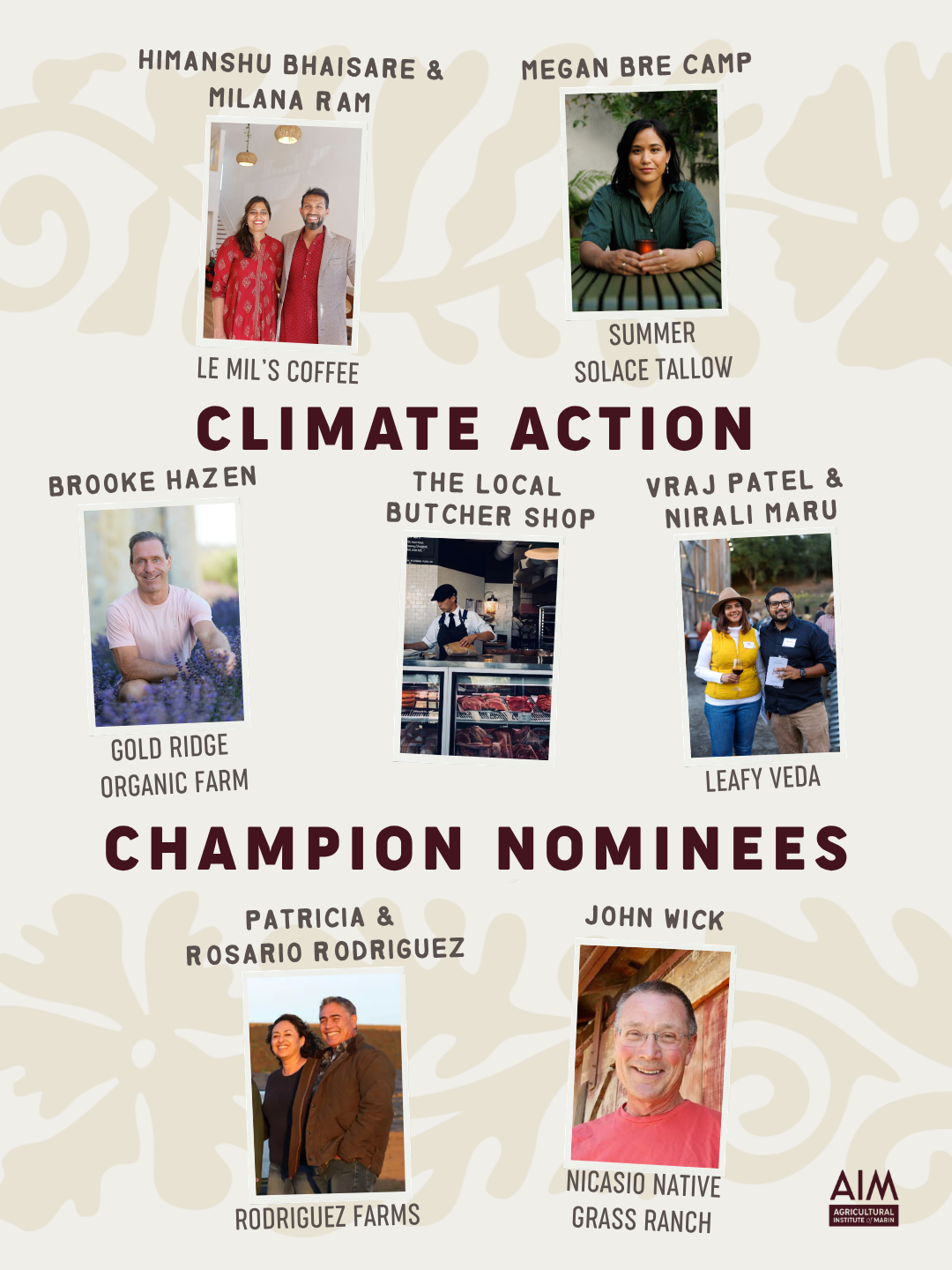
The Climate Action Champion Award is presented every year at Gather for the Planet. The award recognizes a local producer or artisan who is demonstrating climate action through one or more of the following nine criteria:
Climate-Friendly Agricultural Practices
Renewable Energy
Green Transportation
Energy Efficiency in Infrastructure
Reducing Food Waste
Reusable Foodware and Packaging
Upcycling
Environmental Justice
Sustainable Arts and Design
We are so pleased to have seven nominees to announce this year. The winner will be announced and invited on stage at this year’s Gather for the Planet on October 10, 2026.
Himanshu Bhaisare and Milana Ram, Le Mil’s Coffee
Berkeley, CA | Newark Farmers Market
Milana Ram immigrated to the United States from southern India in 2008. She spent the next two decades worrying about the future of her family’s coffee farm in Chikmagalur, whose history dates back to the 1920s. In 2023, when Ram’s parents started thinking about selling the property, which has been in the family for five generations, Ram and her husband, Himanshu Bhaisare, decided to save it by starting a coffee company. They launched Le Mil’s first as an online shop and popup at the Newark Farmers Market. On Aug. 15, Ram and Bhaisare opened Le Mil’s at 1330 Polk St., where it is San Francisco’s only brick-and-mortar café dedicated to Indian specialty coffee. Ram and Bhaisare hope to educate Bay Area customers about the flavor profiles of Indian coffee.
Megan Bre Camp, Summer Solace Tallow
Oakland, CA | Grand Lake Farmers Market
Megan founded Summer Solace Tallow in 2014 as an extension of her life's work and values. The small, woman-run business is devoted to crafting slow-made, deeply nourishing skincare and home goods using organic, regionally sourced, and regeneratively produced ingredients. Everything is created by hand, with care, intention, and respect for every ingredient.
She sees tallow not as a trend, but as a time-honored material that had quietly sustained generations before us. Summer Solace Tallow reflects acknowledgment and respect for the Earth, seasonal rhythms, whole-animal stewardship, and aromatherapy. Every ingredient used is sourced intentionally from ethical partners. These relationships are foundational to the integrity of the work. Each product created is designed to support real skin wellness while honoring sustainability, transparency, and care at every step. Summer Solace Tallow and our Slow Body Care Movement® honors a lineage of healing and offering skincare that people can truly trust.
Brooke Hazen, Gold Ridge Organic Farm
Sebastopol, CA | Thursday Marin Farmers Market
Since founding Gold Ridge Organic Farms in 2000, Brooke Hazen has been dedicated to organic farming, sustainable practices, and the promotion of healthy, farm-to-table foods. His holistic approach to agriculture integrates environmental stewardship, renewable energy, and community engagement, working in harmony to ensure a thriving, sustainable farm ecosystem.
Certified Organic: Our olive, apple, and citrus orchards, as well as our estate mill, are Certified Organic by Oregon Tilth (OTCO), ensuring adherence to the highest sustainability standards.
Closed-Loop Farming: We maintain a regenerative system where olive waste, including pomace and olive water from the mill, is recycled back into the orchards, enriching the soil and nourishing our trees.
Carbon Farming: We implement carbon sequestration practices to enhance soil health, increase biodiversity, and reduce greenhouse gas emissions, contributing to climate resilience.
Land Conservation & Agricultural Preservation: Gold Ridge Organic Farms’ 88 acres are designated as an agricultural conservation easement, and as agricultural preserve and open space under the Williamson Act, ensuring the continued legacy of Sonoma County’s agricultural heritage.
Wind Power: A visible landmark on the property, our wind turbine harnesses the prevailing maritime breezes to contribute to the clean energy grid.
Electric & Battery-Powered Equipment: Our investment in Monarch electric tractors and battery storage reduces our carbon footprint while also powering farm operations and events sustainably.
Water Stewardship: Our farm relies on well water, carefully managed to support the land while ensuring conservation. We utilize drip irrigation to target the roots and enhance plant vigor while minimizing water waste via evaporation.
Local Food Security & Agricultural Preservation: We are proud supporters of Committee on the Shelterless (COTS), LandPaths, and Ceres Community Project.
Eco-Friendly Packaging: We prioritize sustainability in our packaging, using recyclable glass bottles and tins, biodegradable cups for tastings or washable materials in our tasting room, and minimizing plastic use throughout the farm. Packaging and shipping materials are recyclable and/or made with post-consumer paper materials. The kraft krinkle paper inside of your olive oil boxes can be repurposed as compost for your garden, bedding for small domestic mammals or birds, or in children’s art projects.
The Local Butcher Shop
Berkeley, CA
The Local Butcher Shop is an award-winning neighborhood butcher shop, run by a team of proud worker-owners, providing the best locally sourced, sustainably raised meat for our community. They are dedicated to seasonal, locally sourced, sustainably-raised, fresh meat. The shop began as an idea in 2009 when Aaron and Monica Rocchino decided they wanted to continue their work in the food industry to have a more direct impact on their community. At the same time, it was difficult to find locally sourced, sustainably raised meat to cook at home. The doors opened in August of 2011 in the Gourmet Ghetto neighborhood of Berkeley, CA to help the community solve this situation. In 2021, the Rocchinos stepped back to make way for the team to take over ownership and operation of the butcher shop.
Monica Rocchino is the AIM Board of Directors Parliamentarian.
Vraj Patel and Nirali Maru, Leafy Veda
Stockton, CA | Newark Farmers Market, San Rafael Summer Market
Vraj and Nirali, the heart and soul behind Leafy Veda, come from diverse backgrounds to share a common passion for all-natural farm to table freshness. Vraj being an IT professional, has deep family roots in farming spanning six generations. His love for nature perfectly complements Nirali's background in healthcare and her dedication to promoting proactive wellness & holistic well-being. Nirali is an Occupational Therapist and an Autism Specialist. Together, they embarked on a journey to cultivate health and happiness. A shared vision to produce healthy, all-natural food with zero pesticides/chemicals.
Leafy Veda is not just about growing microgreens; it's about fostering a community where health, sustainability, and deliciousness intersect. Each microgreen variety they grow is a testament to their commitment to quality, freshness, and the vibrant energy of nature. By embracing vertical farming, they grow nutrient-rich microgreens sustainably and efficiently.
Patricia and Rosario Rodriguez, Rodriguez Farms
Watsonville, CA | Thursday and Sunday Marin, Stonestown, Newark, and Hawyard farmers markets
Rodriguez Farms started in 1991 with 3 acres of strawberries in Watsonville, California along the Monterey Bay coast. They have been certified organic with C.C.O.F and U.S.D.A since 2004. Every year they test and make changes to use natural farming practices. They have developed a tractor mounted vacuum system to remove pests from our plants and avoid using harmful pesticides. They also grow other plants that are beneficial to organic farming. Since they started their goal has been to grow quality fruit and offer the best to their customers. Their customers return year after year and their new fans have helped them grow to a 120 acre farm split between Watsonville and Castroville overlooking the Monterey Bay. They plant an average of 60 acres per year in order to let the other half of the soil rest. This allows the soil to replenish its nutrients and produce better quality crop. Due to customer demand they have also added a wide variety of berries and vegetables.
John Wick, Nicasio Native Grass Ranch
Nicasio, CA
John cofounded both the Marin Carbon Project and the Carbon Cycle Institute, and has independently led statewide educational campaigns, supported new laws related to healthy soils and compost, and built functional economy-wide models for rebalancing the global carbon cycle.
His ranch is 540 acres of coastal prairie system. His first approach to managing this landscape was to leave it alone. It was his assumption that nature would heal itself, and we could create wilderness by basically just watching. But that didn’t happen. Working with living systems required observation and a more benevolent participation. So, he introduced intentional disruption in the form of an occasional grazing event, he did very light touches on the landscape and started to see spectacular results. He started to actually see whole systems of native plants appearing on their own without planting a seed. Wildlife is abundant and many unique wildflower species are on riotous display in the spring. Areas treated with compost continue to produce above average forage and remain greener longer in the drier season.
His approach focuses on applying carbon back into the soil topically using compost, a biologically stable form of carbon. Microorganisms can then pull the soil as a part of their normal life processes and feed the microorganism population. Marin found that the biggest soil carbon stocks occurred in lands that had manure applied to them historically. This finding led to the theory that adding carbon to the top of the soil could create an ongoing carbon sink in grasslands. Working with the USDA Natural Resources Conservation Service they created the COMET-Planner, an online calculator that allows landowners to estimate soil carbon benefits from over thirty USDA approved conservation practices. Working with the local dairies, fiber producers and non-profit partners they also began to build the regional rangeland producers ability to increase the value of their products though community and corporate investments in on-farm and regional agricultural processing and manufacturing infrastructure centered around climate beneficial products.